Build, buy, or ready-made intelligence? Making sense of the options.
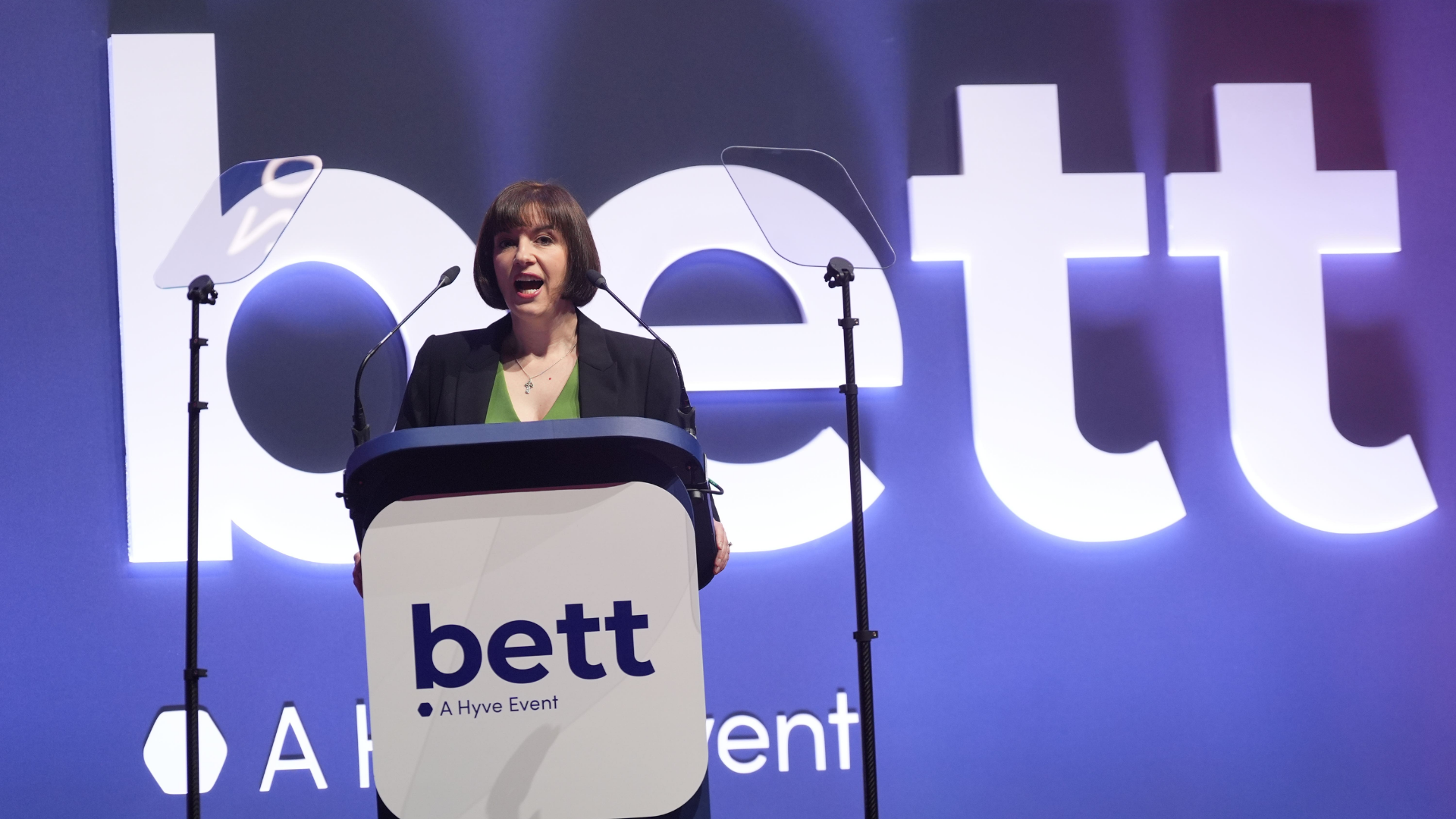
At BETT 2026, the Education Secretary set out five goals for AI in education, including what she described as “a data-driven school system” with “a new data spine and open data standards to connect and share information — unlocking the insights that were previously trapped in closed systems.”
That phrase — “insights trapped in closed systems” — will resonate with many trust leaders. School group data is often fragmented across multiple systems — attendance sits in different school’s MIS systems, assessment data in another platform, and behaviour is tracked somewhere else. HR sits in yet another system, and the documents that hold your strategic thinking — improvement plans, Ofsted reports, SEFs — sit in a shared drive, disconnected from it all.
The result is that leaders spend many ‘hidden’ hours each week acting as data processors: exporting CSVs, cross-referencing spreadsheets, and stitching together information that should flow naturally.
As the accountability landscape intensifies, Academy Trust Inspections are on the horizon, with a focus on leadership, governance, and evidencing impact across your schools. The new Ofsted Report Card system demands clear evidence of how schools identify issues, what you do about them, and whether it works. Trusts that can demonstrate this quickly and confidently will be in a strong position.
What disconnected data actually costs
Before exploring the options, consider what fragmented data might be costing you in real outcomes:
- Missed interventions. When data is fragmented and hard to access, patterns and trends are missed.
- Slower response times. By the time data is reviewed and cross-referenced to confirm trends — for example, in persistent absence — weeks may have passed. In a connected system, patterns surface in minutes.
- Inconsistency across schools. Without a shared intelligence layer, each school may interpret data differently.
- Lost leadership capacity. Every hour spent processing data is an hour not spent on the work that will deliver school improvement. If we want leaders focused on the right things, we need to remove the drudgery of manual analysis.
Three approaches to data strategy
There are broadly three routes trusts can take when addressing their data strategy. Each has strengths and trade-offs. This guide sets out what each route involves in practice.
1. Build your own infrastructure
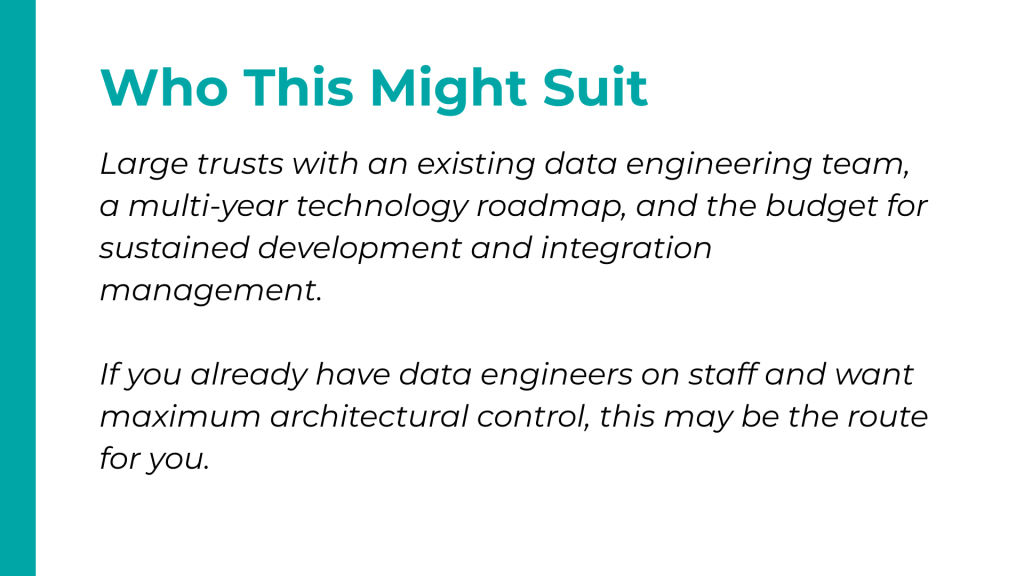
This approach focuses on building the plumbing of your trust’s data architecture. You create a centralised data store (often called a data warehouse, lake or lakehouse), build pipelines to feed data into this from various systems, and then develop your own reporting and analysis tools on top. In other words, you’re building the foundation, and then building what sits on it.
Some initiatives provide open-source frameworks for this, and this is helpful for trusts taking this route. Shared approaches mean trusts are not starting from scratch.
This can seem appealing, and for some trusts it may well be the right choice. The potential benefits include full ownership of your data architecture and the ability to customise every report. For large trusts with existing data engineering teams, strong budgets, and the appetite for a long-term technology project, it can work well.
Trust leaders do need to consider what “build” actually involves. ‘Open’ or ‘not for profit’ does not mean free. The software frameworks may be open, but you still need people to implement, maintain, and develop them. That typically means a dedicated data engineer (likely from £50,000+) and a data analyst or scientist alongside them, if you want to be able to quickly make sense of the data you connect. You’ll also need cloud hosting, ongoing maintenance, and the internal capacity to manage the different data layers.
There is also a need for integrations. Building pipelines means managing APIs, data-sharing agreements, and technical relationships with every system you connect to — your MIS, assessment platform, HR system, and more.
You’ll also need to consider how intelligence is delivered to the people who need it. A data lakehouse gives you connected storage, but it does not automatically give you AI-powered analysis, natural language queries, or recommended actions across all your data and documents. Those capabilities need to be designed, built, and maintained as a separate layer — each with its own running costs.
2. Purchase dashboards
This is a common approach for trusts. You commission bespoke dashboards (typically built on Power BI or similar tools) that help visualise your data. Some providers offer pre-built toolkits for attendance or assessment; others build fully custom views for your trust.
Good dashboards can genuinely help. They reduce the time leaders spend hunting for data, provide a shared view across schools, and, when done well, make complex information more accessible.
The limitation is in what they ask of your leaders. Dashboards show you what happened — but they rarely explain possible causes, and they never suggest what to do about it. Leaders still have to manually filter, drill down, cross-reference sub-groups, and piece together a narrative from charts. The analysis burden has not gone away — data is just more accessible and with a nicer interface.
It is also worth understanding the data limitations. Depending on the vendor, dashboards may be restricted to a single data source per view, offer only limited joining up across systems, or require bespoke, costly integrations to bring different data sets together. What looks like a unified picture may actually be several separate views side by side, each with gaps between them.
Many platforms also use “AI” as a marketing label without genuine intelligence behind it. If you cannot ask a question in plain English and receive an evidence-backed answer about your data, it is most likely a dashboard with AI branding, or a chatbot — not AI specifically built for the education sector and the task at hand.
3. Ready-made intelligence
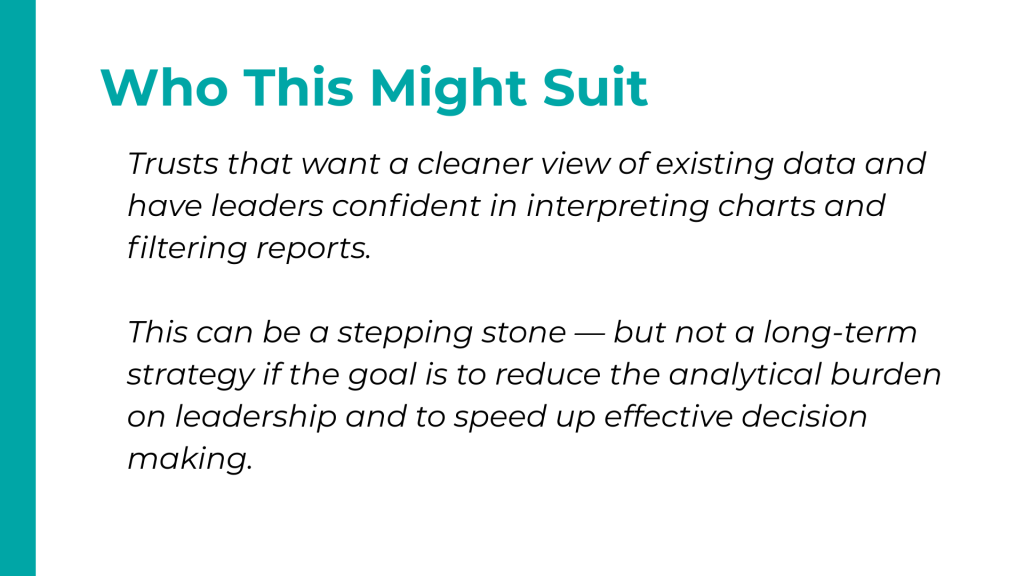
This approach treats data intelligence as a service rather than a project. Instead of building infrastructure or commissioning dashboards, you connect your existing systems to a platform that creates and manages a data lakehouse for you, and allows you to analyse it using natural language. Data flows from your systems and documents automatically; AI-powered insights flow out, and no data team is required.
The best platforms in this space go beyond dashboards in three key ways.
First, they can connect anything (this may require the cooperation of any system owner where this is not you, such as suppliers), not just the numbers in your MIS. This will also include HR data and your unstructured documents — improvement plans, Ofsted reports, policies — that hold your strategic context.
Second, they help you understand the data: using secure AI specifically designed for education, they help you investigate patterns, identify root causes, automatically identify sub-groups, check for relationships, and explain why something is happening.
Third, they help you act: delivering recommendations, tracking progress, and generating evidence-ready information for governors, trustees, and inspectors.
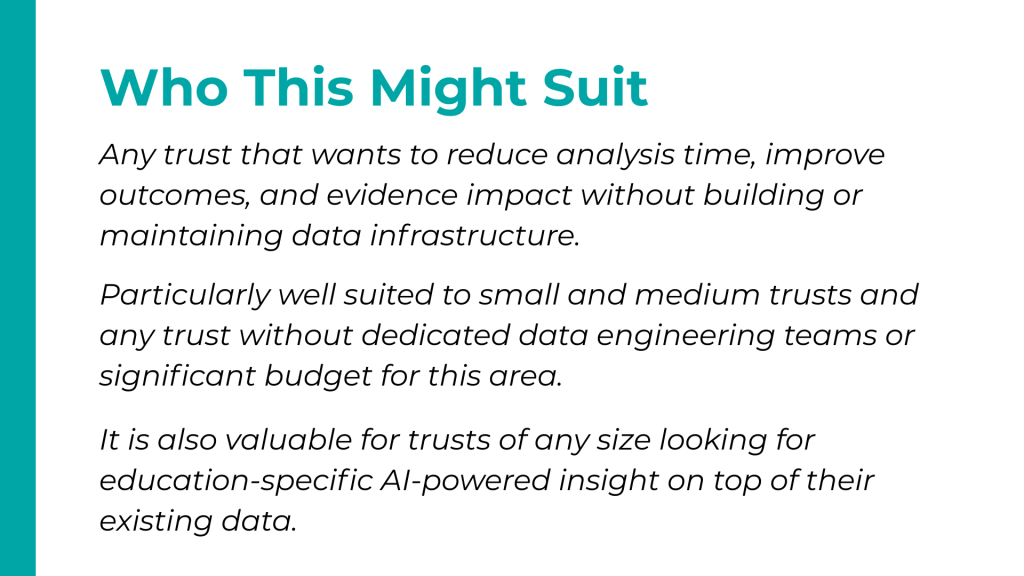
One of the most significant benefits of this approach is that it puts intelligence directly into the hands of every leader, and quickly — not just those with the data skills or ability to ask a data analyst. Every leader from across the trust can get instant answers about their data and documents. Each school within a trust has its own AI-powered view of their data, while the trust leadership sees the whole picture. Ready-made intelligence platforms can quickly provide democratisation of insight — the headteacher in your smallest primary school has the same analytical power as your central team.
Comparing the three approaches
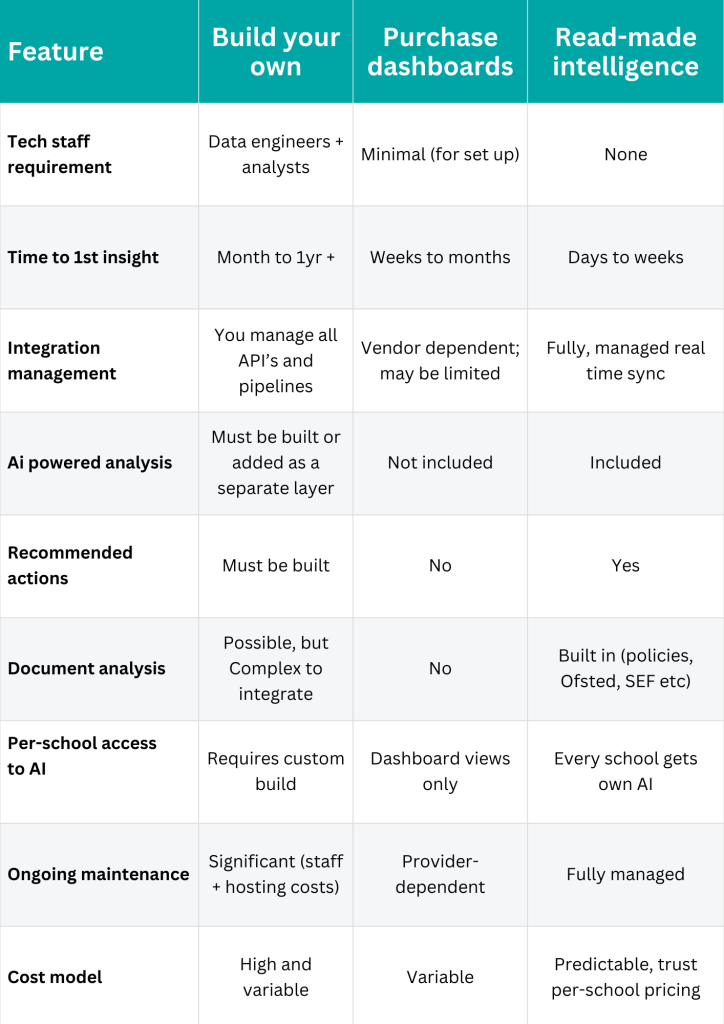
Five Questions to Guide Your Decision
1. Capability
Do you have data engineering capability?
Not just reporting capacity, data processing team or analysts who run reports from your MIS — but the ability to build and maintain data pipelines, manage cloud infrastructure, and develop and support advanced analytics or AI tools. If not, the “build” route usually means hiring that capability or buying it in.
2. Timeline vs value
How quickly do you need this to change decision making capability?
Many trusts and their schools are struggling with disconnected data and a lack of easily accessible insights now — a multi-year infrastructure project will not solve this problem quickly.
3. Autonomy
Who needs access to data intelligence?
If the answer is just the central team, dashboards can be a pragmatic step. But if you want school and Trust leaders (headteachers, SENCOs, DSLs and others) to have analytical power over the data relevant to their setting and responsibility, without specialist skills, you need something different.
4. What kind of answers do you need?
Do you mainly need visibility or understanding and next steps?
Dashboards and data lakes answer the first question well, but require manual analysis. Only platforms with ‘genuine’ AI analysis answer the last two.
5. What does ‘data’ really include?
When you say “data”, do you mean MIS metrics — or your full evidence base?
If it means the numbers in your MIS, most solutions can help. If it also includes data from different systems, policy documents, improvement plans, stakeholder feedback, and unstructured context — the intelligence that really drives school improvement — you need a platform that can read and analyse all of it together.
We offer a free, no-obligation consultation to help trust leaders think through their options.
Email mark@edu-intelligence.ai or click the link below
The Goal Is Not Data. It Is Better Outcomes.
It is easy to get drawn into the technology needed. Data lakehouses. Dashboards. AI agents. Open standards. But the purpose of all of this is simple: to help improve outcomes for all.
When leaders can see the full picture quickly, they intervene earlier. When AI investigates sub-groups automatically, disadvantaged pupils and those with SEND stop falling through the gaps. When documents are analysed alongside operational data, schools understand the why behind the what. When progress is tracked in real time, trusts can evidence impact with confidence — not just to inspectors, but to themselves.
The government’s vision of a data-driven school system is the right one. The question for each trust is not whether to act, but how quickly you can move from scattered data to clear action.