Most people who work in schools didn’t need convincing — even before this White Paper — that the SEND system needed to change.
Families are worn down by delay and conflict. SENCOs and pastoral teams are stretched. Heads and trust leaders are trying to do the right thing while juggling staffing gaps, tightening budgets, and a level of need that has risen fast and doesn’t sit neatly inside job descriptions.
Behind every plan and review are people who care. Teachers, TAs, SENCOs and pastoral teams are already doing the day-to-day work: adjusting, reassuring, problem-solving, and keeping children in school when it’s hard. The pressure comes when that care has to be turned into evidence — repeatedly — on top of everything else.
The reforms aim to move us to a better place: earlier support, stronger mainstream inclusion, and legal protection. The risk, however, is practical: support can only improve when schools can act quickly, consistently, and with confidence — and that depends on evidence and capacity in a system that is already stretched.
What schools are already carrying
The system is big: around 1.7 million pupils receive SEND support in school, with 483,000 of these having an EHCP. Across ages 0–25, this increases to around 639,000.
EHCP processes are not light-touch. Annual reviews mean gathering reports and views, pulling together outcomes and provision, recording changes, and meeting transition deadlines — no matter how busy the term is.
Now add ISPs into that picture — including annual ISP reviews — and it’s easy to see how quickly the evidence workload scales.
A lot of the pain in SEND isn’t “a lack of care”. It’s that the admin and evidence burden eats into time that should go into support.
What changes with ISPs and transition reviews?
With ISPs, the scope widens dramatically. More children have a legally underpinned plan. EHCPs become more tightly associated with the most complex needs. Review points at transition (particularly primary to secondary) become central.
In simple terms: more plans + more reviews = more evidence required, more often.
As EHCPs become more tightly associated with the most complex needs, more pupils will sit under ISPs, this shifts the practical workload onto schools. And it’s not “EHCP or ISP”: pupils with EHCPs will also need an ISP, reviewed every year. So the volume challenge isn’t just the number of new ISPs — it’s the annual review cycle on top, across a much larger group of pupils than most schools currently maintain formal plans for.
The White Paper itself is clear that EHCPs continue to set out a child’s statutory entitlement, with ISPs describing the day-to-day provision delivered in schools — so the plan workload is additive, not replacing one thing with another.
Tim Handley — a former headteacher and now Chief Technology Officer at Edu Intelligence — puts it plainly:
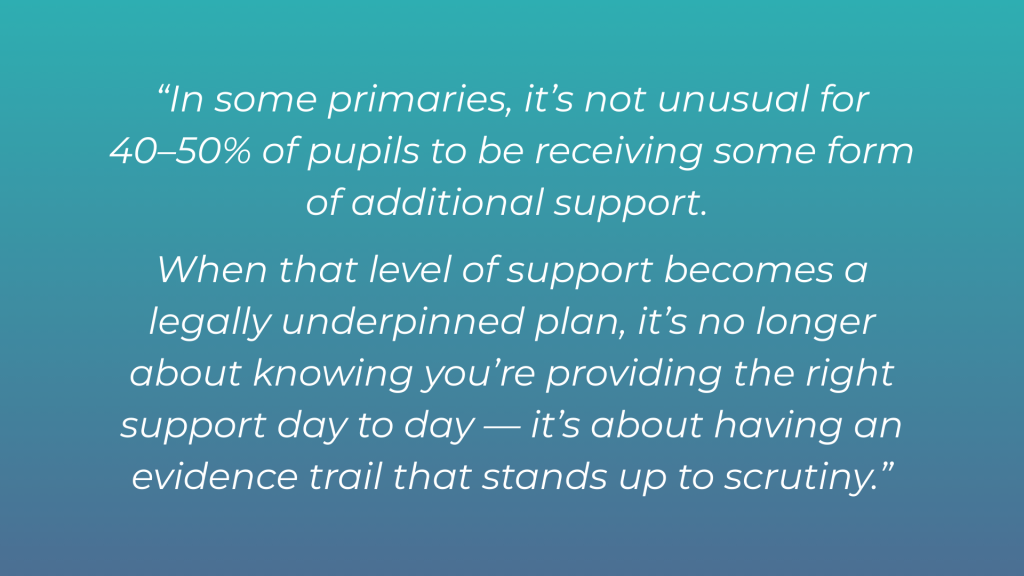
If the evidence piece isn’t made simpler, ISPs risk becoming EHCP-lite in the worst way: lots of documentation, patchy delivery, and families still feeling like they have to push and prove at every step.
And that’s where parent trust can unravel — not because the intent is bad, but because they don’t experience intent. They experience outcomes.
The evidence problem nobody has time for
As the White Paper puts it:
““Information about children’s needs is often fragmented across multiple systems, making it harder to keep records accurate and up to date.”
That looks like:
- Attendance, behaviour, attainment and progress data
- Provision maps and intervention records
- Safeguarding/pastoral logs
- Teacher observations and meeting notes
- External reports and letters
- Ongoing communications with families
When evidence is scattered, teams end up rebuilding the story again and again — for reviews, transitions, panels, complaints, and the next conversation with a parent who wants clarity.
This is the avoidable workload. It doesn’t help a child, but it drains the adults trying to help. It quietly eats into the time that matters most: noticing early signs, supporting families, coaching staff, and keeping provision consistent day to day.
A practical way to make this deliverable
We welcome earlier support, mainstream inclusion done properly, and legal protection that reduces adversarial battles. But none of it works unless it’s deliverable in real schools, under real pressure.
That’s exactly why we built Edu Intelligence: to help leaders and SEND teams turn scattered evidence into clear, plan-ready evidence — faster and more consistently — so time goes into support and improving outcomes, not more admin.
The best SEND support is built on relationships and professional judgement — the human work of understanding a child and adapting around them. The challenge is pulling together the evidence needed to protect that support and keep it consistent through reviews and transitions.
So what is Edu Intelligence?
Edu Intelligence (EI) is an AI-powered platform built specifically for schools and trusts. It connects the information you already have — across data systems, documents and stakeholder voice — and turns it into usable evidence.
In plain terms, it helps leaders and SEND teams assemble what they need without days of exporting spreadsheets, chasing notes, and stitching it all into something coherent.
It’s not about replacing professional judgement. It’s about removing the time-sink between “we know what’s going on” and “we can evidence it, act on it, and show what changed”.

Working at the level of an individual child — including documents
This is where SEND lives in the real world.
EI is developed so schools can go down to the individual child level and attach the documents that carry the SEND narrative: therapy notes, reports, meeting notes, and uploaded parent correspondence.
When someone needs a review summary or plan draft, the system can take those documents into account, alongside structured data such as attendance and behaviour.
That’s how you avoid “generic SEND language” and produce plans that reflect the real picture for every pupil.
How does this work in practice?
For EHCP reviews and ISPs at scale, this means the child’s evidence chain is already there — you’re not starting from a blank page or stitching it together.
Here’s what that looks like day-to-day:
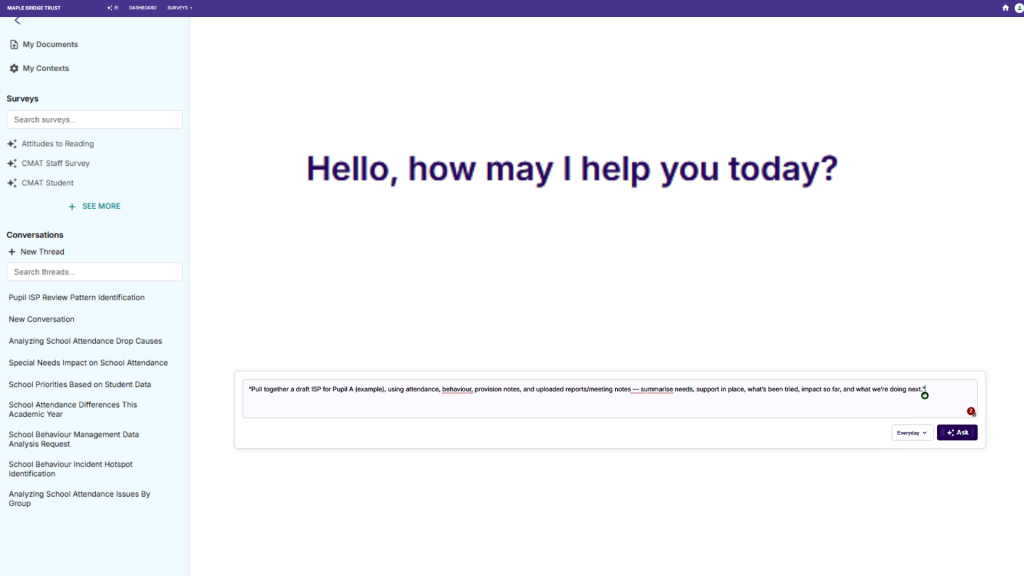
You type: “Pull together a draft ISP for Pupil A (example), using attendance, behaviour, provision notes, and uploaded reports/meeting notes — summarise needs, support in place, what’s been tried, impact so far, and what we’re doing next.”
Turning voice into something usable
EI can generate a structured draft, with the supporting evidence traceable back to the source so SENCO time goes into judgement and next steps, not admin.
The White Paper is clear what ISPs must capture (barriers to learning, day-to-day provision, reasonable adjustments and intended outcomes). EI can map joined-up evidence into that structure and keep it current — without the workload, with security built in so the AI operates without access to identifiable pupil data.
ISPs only build trust with families if they can see that their input changes what happens next.
EI can pull in stakeholder voice (parent, pupil, staff) and connect it to evidence and action, making it easier to show a simple loop: what we heard, what we did, and what changed.
That reduces conflict and protects staff — because it makes decision-making clearer, quicker and less vulnerable to “he said / she said” dynamics.
What leaders should keep an eye on
If you’re leading a school or trust, the detail that matters won’t be the labels. It’ll be things like:
- What counts as “ordinarily available” in mainstream — and how it’s evidenced
- How ISPs are expected to be written, reviewed, stored and shared with staff (especially in secondary)
- What the route is when a parent disagrees with an ISP
- How transition reviews are resourced so they don’t become a cliff-edge for support
- Whether commissioning budgets come with the practical capacity to source and manage therapy and specialist input
- How you’ll run annual ISP reviews at scale (including EHCP pupils), without creating a workload spiral for SENCOs and pastoral teams
Those points will decide whether the reform reduces the fight or simply moves it to a different part of the system.
There’s a version of this reform that genuinely improves lives: earlier help, clearer plans, and fewer families feeling forced into conflict just to secure basic support.
That version only happens when schools have the tools to keep evidence coherent and current — and when the people closest to pupils spend their time supporting children, not stitching together paperwork.
If you’re a trust or school leader looking at ISPs and transition reviews and thinking, “We want this to work, but how do we deliver it at scale?”
We’ll show you what joined-up SEND evidence looks like in practice, including how child-level plans can reflect the real narrative (not just the data).